The Reviewer Is Referring to Serviceability When Mentioning
In Romania, the value of online shopping reached 2.eight billion in 2017, 40% more than in 2016, being one of the highest increases in the European Union. However, the eastward-commerce market value is notwithstanding small compared to other European countries, one of the master reasons that people prefer non to purchase online is mistrust in the quality of the products offered. In order to proceeds insights into the criteria used past Romanian consumers to evaluate product quality, we conducted eight in depth interviews. The results show that there are a lot of similarities between attributes used to evaluate product quality in a physical store and attributes used to evaluate product quality in an online store. Meanwhile, the differences consists in the presence of customer reviews as the most relevant attribute for the online stores and price equally the nigh relevant attribute for physical stores.
Keywords Online Store Concrete Store Production Quality Product Quality Evaluation
JEL Nomenclature L15, L20, L81, M30, M31
Full Article
1. Introduction
Product quality is a very of import factor considered when making a purchasing conclusion for goods and services. A study by InfoCons investigated the criteria that Romanians consider when choosing to place a production in the shopping cart. The results found the following factors that influence the purchasing decision, presented in order of their importance: the price - eighty% of the Romanians choose the products according to the price. Romanians tend to choose the cheapest products: "the lower the price of a food, the greater the chances that the product will reach the shopping cart" (Spiridon, 2017). Another important criterion is quality, 74% of consumers consider quality to exist important or very important, followed by brand and package.
In this paper, we explore how consumers assess product quality past investigating which are the attributes used to define a loftier and a low quality product. Nosotros also explore if at that place is whatsoever difference betwixt attributes used to evaluate product quality in a concrete store and attributes used to evaluate product quality in an online store. The involvement for the online surround is motivated by its evolution experienced in recent years. In Romania the value of the e-commerce market in the total retail market registered a proportion of 5.6%, in 2017, up from iv% in 2016. The variety of online stores can be remarked, with vii,000 relevant online shops in terms of traffic and orders in 2017, compared to 5000 online stores in 2016. Out of the v,000 active online stores in the Romanian eastward-commerce landscape in 2016 "approximately 200 are large and medium businesses, exceeding 1 1000000 EUR in annual turnover" (Radu, 2016). Considering this information our focus is on understanding how a consumer evaluates the production quality in concrete stores versus eastward-commerce.
We obtained our information from eight semi-structured in-depth interviews. Offset nosotros developed an interview guide to help us to accost to the most important aspects for our research. Each discussion was individual and summed up how the product quality is perceived by the respondents as well as the particularities of how a production is evaluated in the online environment versus a concrete shop. After analyzing the data we obtained seven categories of of import attributes used in product quality evaluation based on the variables identified previously in the literature.
Defining the most important attributes that consumers use to assess the product quality is very difficult. Zeithaml (1988) sustains that "specific or physical intrinsic attributes differ widely across products, as do the attributes consumers utilise to infer quality. Plain, attributes that point quality in fruit juice are non the same as those indicating quality in washing machines or automobiles. Even inside a product category, specific attributes may provide unlike signals about quality" (Zeithaml, 1988, p. 7). In order to obtain representative data the attributes must be abstract so information technology could exist applied to more alternatives.
This paper aims to provide answers to questions such as: "What exercise consumers sympathise by the "quality" construct?"; "Which are the variables that lead consumers to evaluate a production as high or depression quality?" and "Are there differences between how a consumer evaluates the product quality in a physical shop and how the aforementioned product is evaluated in an online store?".
two. Literature Review
Product quality cess requires a systematic review and comparison of competing products in a product category (Maeyer and Estelami, 2011). Perceived quality is a theme that captures the interest of many researchers because of cultural differences that tin pb to different assessments of this concept and besides due to changes in the market and in consumer preferences (Tsiotsou, 2005; Bei and Chiao, 2001). From the definition of the quality concept to the importance of purchasing quality and how consumers evaluate product quality, all have been research topics for many authors (Ding et al., 2010; Auer et al, 2018; Brucks et al, 2000; Hallak, 2006; Chen and Juvenal, 2016; Burton and Lichtenstein, 1990). In most cases, quality is closely linked to price: a higher quality will require a high price, while a lower quality is characterized by a depression toll (Mean solar day and Stephen, 1986).
Lichtenstein and Burton (1989) distinguish betwixt objective quality and perceived quality. Objective quality is defined every bit the impartial evaluation of the quality of a product, taking into business relationship technical attributes, appearance or durability (Mitra and Golder, 2006). On the other hand, the perceived quality refers to "the overall subjective judgment of quality relative to the expectation of quality. These expectations are based on one's ain and others' experiences, plus diverse other sources including make reputation, price, and advertising" (Mitra and Golder, 2006). When we talk about the production quality, nosotros must be aware that the cess tin be made at the fourth dimension of purchase or at the point of consumption. Zeithaml (1988) argues that when the cess is fabricated at the point of consumption, intrinsic attributes such as taste or odour have a college importance in determining product quality because they have a greater predictive value than extrinsic attributes. However, many assessments are made at the time of purchase when there is bereft information about intrinsic attributes, and so extrinsic attributes such as brand, price, warranties or packaging becomes more of import. At this indicate nosotros have evidence that both intrinsic and extrinsic attributes weigh in the consumer assessment procedure, without being able to tell which one weighs the near in determination making process.
Many authors have investigated over time what are the nigh important attributes that consumers are considering when assessing the production quality. Garvin (1987) argues that a product'south assessment in terms of quality can be made on eight dimensions: performance, perceived quality, serviceability, conformance, durability, reliability, aesthetics and features. Co-ordinate to Garvin, the performance refers to the primary features of the product or the measurable attributes (for example for a television functioning means image clarity). Features, the second dimension, are ofttimes a secondary aspect of performance and represents features that complement the core functionality (for example, the availability to purchase a production in different colors or sizes). Reliability reflects the likelihood of a product malfunctioning or not working for a certain corporeality of time. This dimension is more characteristic of long life products than for instant consumption products and services. Durability refers to „the amount of employ ane gets from a product earlier it deteriorates" (Garvin, 1987). Conformance can be defined as the caste to which the main features of a production meet the established standards. Serviceability refers to subsequently sales services and measures the kindness of the employees, the speed, the competence and the ease of repair of a product. The aesthetic aspect refers to how a product looks, how it feels when it'southward touched, how it taste or aroma. The last dimension, perceived quality refers to all external sources that can assist the consumer to form a perception almost the quality of a product. Co-ordinate to Garvin advertising and brand reputation are elements of perceived quality.
Brucks and Zeithaml (2000) identify half dozen abstruse dimensions based on which consumers assess durable goods quality: ease of use, functionality, operation, durability, serviceability and prestige. Three of the six dimensions identified are identical to those previously proposed by Garvin: performance, durability and serviceability. The ease of utilize refers to the complexity of long life products that have get overwhelming in recent years. Therefore, in spite of their complexity, in order to have a high quality, the products must be easy to use, without requiring much effort and prior training. Functionality implies the amount and complexity of features that distinguish the model from a standard model. Prestige implies the visible features of the product, such as advent, merely also includes a less tangible social component that reflects on the image of the product or brand.
Aesthetics, also, has a symbolic function that influences how a product is understood and evaluated in terms of quality (Bloch, 2003). This dimension has raised the involvement of researchers, who mainly studied the office of packaging in product evaluation (Magnier et al., 2016; Steenis et al., 2017; Simmonds and Spence, 2017; Ooijen et al. 2017; Westerman et al., 2013). Simmonds et al (2018) conducted a study to investigate how transparent packaging influences product attractiveness, willingness to pay, gustation expectations, product freshness expectations, perceived innovation and perceived quality. They showed to respondents three variants of pattern packaging of a production: one with a transparent window through which the product could be seen, one had a picture with a proposition for serving, and the last variant had just the brand and product name with no flick or transparent window. The results of the study have shown that transparent windows in the design packaging lead to a positive assessment of the freshness and quality of the products, every bit well equally a higher willingness to pay for several production categories.
Maeyer and Estelami (2011) fence that a large number of consumers are experiencing difficulties in evaluating a production quality, and often rely on external data such as third-party opinions, toll or advertising content to form an opinion on product quality. Starting from this point of view, they have proposed to evaluate how 3rd-party product ratings organizations that provide consumer information in the course of adept reviews or other consumers testimonials influence consumer perceptions of product quality. The results accept shown that the consumer confidence in the provided data tin be significantly influenced past the mode in which product quality information is communicated to the consumer. For instance, for tangible goods, consumers value more the experts testimonials on product quality.
Grohmann and Spangenberg (2007) studied the extent to which consumers evaluate the products quality differently when they are immune to touch on them. The features of each production were shown on a whiteboard forth with the bulletin "If y'all desire you tin touch the production" or "Please do not bear upon the product during the evaluation." The results showed that college quality products that could be touched have benefited from more favorable evaluations from the respondents. With regard to low quality products, the tactile contribution did not lead to less favorable assessments.
three. Research Methodology
To obtain our data, we accept conducted eight semi-structured in-depth interviews. There were 30-45 minutes individual discussions on how production quality is perceived by respondents as well equally on particularities of how a product is evaluated. Nosotros used an interview guide structured equally follows: questions near the significant of the quality concept in general, questions near the attributes considered when product quality is evaluated and questions about the particularities of how the evaluation is done in a concrete store and also in an online store. The sample was a convenience one, consisting of 8 people (four women and 4 men) anile betwixt 24 and 35, with higher education level and urban backgrounds who are familiar with the online environment and who interact at least once a day with information technology - regardless we are talking about social networks, online stores or online newspapers / magazines.
For the data analysis, we used an emergent coding procedure. Coding was done by the interviewer based on the notes taken during the interview. Both the presence and the frequency of the concepts accept been encoded, and the irrelevant data has been eliminated. After we performed a content analysis, a categorization of the main attributes based on their implicit or explicit significance was fabricated.
4. Results
Asked to define „quality" construct, the participants referred both to attributes (see Table i) and to characterizations such every bit: "more benefits that I can savor", "something to satisfy my needs at the most high level, taking into business relationship personal preferences", "a qualification of a production by comparing information technology with the existing alternatives that satisfy the same need". In terms of attributes, quality is associated with immovability, price, high quality raw material and reliability. Regarding the attributes used to evaluate product quality, in Table 1 we can discover a bully diversity, each respondent mentioning at least four criteria that he / she considers when evaluates a product.
Table ane. Atributes used to define quality and production quality
| Atributes used to define quality | Atributes used to define product quality |
| Immovability | Design |
| Fiability | Limerick |
| Loftier quality raw material | Price |
| Price | Brand |
| Satisfying needs without compromises | Package |
| Comparison with other products | Colour |
| Ecological | Aroma |
| Product lifetime | |
| Expiration date | |
| Features | |
| Texture | |
| Sense of taste | |
| Fiability | |
| Like shooting fish in a barrel to use | |
| Origin | |
| Manufacturing Technology | |
| Warranty period | |
| Wear Resistance |
Considering the identified attributes for production quality evaluation, we grouped them in seven categories based on the variables identified in the literature as follows:
- Extrinsic attributes – in this category we included package, origin, manufacturing technology, price, design and composition.
- Intrinsic attributes – in this category nosotros included texture, taste, colour and smell.
- Immovability – we included wear resistance, expiration date, product lifetime, warranty period.
- Prestige - this variable refers to the brand reputation that can transmit information about the quality of the products.
- Product description – in this category we included production features.
- Ease of use.
- Viability.
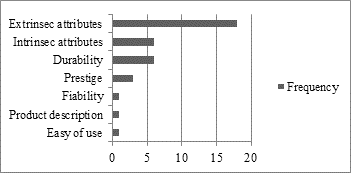
Effigy 1. Variables used to evaluate production quality
From Figure 1 it can be observed that extrinsic attributes are those nearly often invoked when it is necessary to perform a production evaluation in terms of quality. The frequency of extrinsic attributes mentioned by the participants is twice as high every bit the frequency of the second or the third nearly important variable considered in the process of evaluating a product as loftier or low quality. Moreover nosotros can run into that the frequency of extrinsic attributes is equal to the sum of the frequencies of the other six variables identified.
Figure 2 shows united states that in the instance of brick and mortar stores, the price is the most important attribute, seven of the eight people mentioning it. The following attributes of major importance are packaging, the possibility to compare products and durability. In addition to these attributes, there are references to criteria that nosotros consider to be specific to this environment: the possibility to discover other clients preferences or the possibility to affect the product and feel the texture.
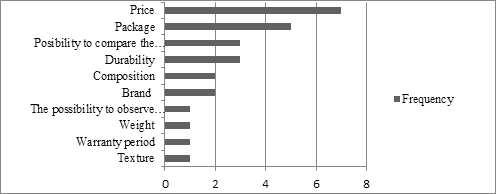
Effigy 2. Specific attributes used to evaluate product quality in brick and mortar stores
Asked to depict the importance of the ownership surroundings, for concrete stores the participants listed advantages like: the possibility to scent and touch the product, the shop pattern offers an advantage in terms of quality product evaluation ("if a shop inspires me trust I go with the idea that the products are loftier quality (even if they are not)"; " the fashion it looks, smells or how merchandise is arranged gives me a clear picture near the kind of products offered"), production exposure facilitates comparisons between products in the same category.
For e-commerce the main attribute of production quality assessment is represented past customer reviews ( see Figure 3). This attribute was mentioned by vi of the eight respondents, its importance beingness amplified by comments such as "If there are no reviews on that site, I search on other sites ", "I search on Google reviews of the product". Simply every bit in the example of concrete stores, the toll and the possibility to compare the actual product with other products are found in the height three criteria. We tin also notice specific elements for online environment, such equally website notoriety, prototype clarity and video presence. In the absence of direct contact with the product, the respondents stated that they demand clear images and, depending on the product, even video elements in social club to make a decision.
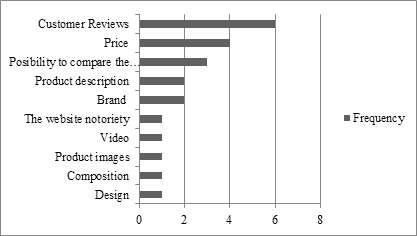
Figure 3. Specific attributes used to evaluate production quality online stores
Co-ordinate to the respondents, the online surroundings presents advantages similar: "you tin notice opinions from persons who have already used the product", "the way a website is built makes me trust almost production quality". There are products that respondents prefer to buy online due to the benefits this surroundings offers. These products belong to electronics or entertainment category ("I can better set the quality of a motion picture if I purchase it from an online store rather than from a physical store. In an online store I can see a trailer dissimilar a concrete store where I can see just two photos on the cover of a DVD"). Nevertheless, for nearly of the products purchased through online stores, there are disadvantages such as: "I feel nervous until the package arrives to see if the products meets my expectations ", "in the case of apparel you cannot touch the material and take to rely just on pictures that in some cases practice not evidence details. The same is applied in the case of perfumes, lotions that you cannot smell".
5. Conclusions
Product quality is one of the nearly important factors considered by Romanians before making a purchase conclusion. Knowing what Romanian consumers ascertain past quality is very important for companies and so they tin choose the right market positioning strategy. However, defining the most important attributes that consumers utilize to assess the product quality is a hard task due to the various features specific to the unlike product categories. The literature offers a series of abstract attributes investigated by different authors: performance, aesthetics, reliability, conformance, functionality, durability, serviceability, features, ease of use, perceived quality, and prestige. We take also seen that extrinsic attributes and intrinsic attributes, which are very of import to consumers, often autumn under product performance.
The results of our report showed consistency regarding the attributes used to evaluate both a loftier quality product and a low quality production. Price is the most of import attribute considered by consumers when they qualify a product equally high or depression quality. Also, the attributes used by respondents to ascertain product quality could be categorized as variables identified past other researchers in the literature. We take therefore seen that for Romanaian consumers extrinsic attributes accept the greatest importance in the process of assessing the product quality. Forth with extrinsic attributes, intrinsic attributes, durability, prestige, reliability, product descriptions and ease of use tin can be met. These dimensions have been previously identified in the literature past different researchers (Garvin, 1987; Parasuman et al., 1985; Brucks and Zeithaml, 2000).
Nosotros also showed that there are similarities between attributes used to evaluate product quality in a physical store and attributes used to evaluate production quality in an online store. On the online environment, the customer reviews attribute has the near importance. Respondents trust and even look for the opinions of people who already purchased and used the product and afterwards that follow the cues offered by cost and results obtained by comparison several products in the aforementioned category. If nosotros talk near how a sure quality is attributed to a product purchased from a concrete store, the price is the primary attribute considered by most respondents, followed past product packaging and the results obtained by comparing several products in the same category.
Our approach has some limits. One of these is that, in the absenteeism of a specific production category that needs to exist evaluated, respondents have reported to a variety of products: from food and clothing to electronic products or furniture. To grade a clear picture of the principal attributes that indicate the quality level of a product was somewhat difficult, especially in the example of intrinsic attributes that differ widely between product categories. Another limit may be the pocket-size sample considered for interviewing. A larger sample would be more representative for the target population concerned. Even so, the consistency of the responses among the eight respondents suggests the being of a core key attributes that defines the mode consumer evaluate product quality. This report can also represent the starting point for future inquiry that can focus on how the quality of a particular product category is assessed in the online environment.
References
- Auer, R. A., Chaney, T. and Sauré, P., 2018. Quality pricing-to-marketplace. Periodical of International Economics, pp. 87–102.
- Bei, L-T. and Chiao, Y-C., 2001. An integrated model for the effects of perceived product, perceived service quality, and perceived price fairness on consumer satisfaction and loyalty. Journal of Consumer Satisfaction, Dissatisfaction and Complaining Behavior, 14, pp. 125-140.
- Bloch, P. H., Brunel, F. F., and Arnold, T. J., 2003. Individual differences in the centrality of visual product aesthetics: Concept and measurement. Journal of Consumer Research, 29(4), pp. 551–565.
- Brucks, Yard., Zeithaml, V. and Naylor, Thou., 2000. Cost and make name as indicators of quality dimensions for consumer durables. Journal of the Academy of Marketing Science, 28(3), pp. 359-374.
- Burton, S. and Lichtenstein, D. R., 1990. Assessing the Relationship Between Perceived and Objective Price-Quality: a Replicatio. Advances in Consumer Enquiry, 17, UT : Clan for Consumer Research, pp. 715-722.
- Day, Due east. and Castleberry, Due south. B., 1986. Defining and Evaluating Quality: the Consumer's View. Advances in Consumer Research, 13, pp. 94-98.
- Chen, N. and Juvenal, L., 2016. Quality, merchandise, and exchange rate pass through. Journal of International Economics, 100, pp. 61–eighty.
- Ding, M., Ross, W. T. and Rao, V. R., 2010. Toll equally an Indicator of Quality: Implications for Utility and Need Functions. Journal of Retailing, 86 (one), pp. 69–84.
- Garvin, A. D., 1987. Competing on the eight dimensions of quality. [online] Bachelor at: https://hbr.org/1987/11/competing-on-the-eight-dimensions-of-quality [Accessed 14 Jan 2018].
- Grohmann, B., Spangenberg, Due east. R. and Sprott, D. E., 2007. The influence of tactile input on the evaluation of retail product offerings. Journal of Retailing, 83 (two), pp. 237-245.
- Hallak, J. C., 2006. Product quality and the management of trade. Journal of International Economics, 68, pp. 238–265.
- Lichtenstein, D. R. and Scott B., 1989. The Relationship between Perceived and Objective Price-Quality. Periodical of Marketing Research, 26(iv), pp. 429-443.
- Maeyer, P. and Estelami, H., 2011. Consumer perceptions of third political party product quality ratings. Journal of Business organisation Research, 64, pp. 1067–1073.
- Magnier, L., Schoormans, J. and Mugge, R., 2016. Judging a production past its cover: Packaging sustainability and perceptions. Food Quality and Preference, 53, pp. 132–142.
- Mitra, D. and Golder, P. North., 2006. How Does Objective Quality Affect Perceived Quality? Short-Term Effects, Long-Term Effects, and Asymmetries. [online] Available at: https://doi.org/ten.1287/mksc.1050.0175 [Accessed 14 Jan 2018].
- Ooijen, I., Fransen, M. L., Verlegh, P. West. J. and Smit, Eastward. G., 2017. Packaging blueprint as an implicit communicator: Effects on product quality inferences in the presence of explicit quality cues, Nutrient Quality and Preference, 62, pp. 71–79.
- Parasuraman, A., Zeithaml, A. V. and Berry, 50., 1985. A Conceptual Model of Service Quality and Its Implications for Futurity Research. The Periodical of Marketing, 49 (iv), pp. 41-50.
- Radu, A., 2016. Official Romanaian eastward-commerce market overview: online shopping exceeded one.4 billion EUR in 2015!. [online] Available at: http://www.gpec.ro/web log/en/official-romanian-eastward-commerce-market-overview-online-shopping-exceeded-1-four-billion-eur-in-2015 [Accessed xiv January 2018].
- Simmonds, G. and Spence, C., 2017. Thinking within the box: How seeing products on, or through, the packaging influences consumer perceptions and buy behaviour. Nutrient Quality and Preference, 62, pp. 340–351.
- Simmonds, G., Wood, A. T. and Spence, C., 2018. 'Show me the appurtenances': Assessing the effectiveness of transparent packaging vs. product imagery on product evaluation. Food Quality and Preference, 63, pp. 18–27.
- Spiridon, C., 2017. Studiu - 80% din români aleg produsele în funcţie de preţ. [online] Available at: http://adevarul.ro/news/societate/studiu-80-romani-aleg-produsele-functie-pret-specialistidintre-doua-alimente-romanul-alege-intotdeauna-e-mai-ieftin1_59747ca25ab6550cb8684b33/alphabetize.html [Accessed 14 January 2018].
- Steenis, H. D., Herper, East. and Van der Lans, I., 2017. Consumer response to packaging design: The role of packaging materials and graphics in sustainability perceptions and product evaluations. Journal of Cleaner Production, 162, pp. 286-298.
- Westerman, S. J., Sutherland, Due east. J., Gardner, P. H., Baig, N., Critchley, C. and Hickey, C., 2013. The pattern of consumer packaging: Effects of manipulations of shape, orientation, and alignment of graphical forms on consumers' assessments. Nutrient Quality and Preference, 27(i), pp. 8–17.
- Tsiotsou, R., 2005. Perceived Quality Levels and their Relation to Involvement, Satisfaction, and Purchase Intentions. Marketing Bulletin, 16, Research Note four.
- Zeithaml, A. V., 1988. Consumer Perceptions of Price, Quality, and Value: A Means-Terminate Model and Synthesis of Evidence. Journal of Marketing, 52, pp. 2-22.
Commodity Rights and License
© 2018 The Author. Published by Dart Investify. ISSN 2359-7712. This article is licensed under a Artistic Commons Attribution 4.0 International License. 
Corresponding Author
Mihaela Știr, Alexandru Ioan Cuza University of Iasi, Romania
schlegelwhoul1975.blogspot.com
Source: https://marketing.expertjournals.com/23446773-602/
0 Response to "The Reviewer Is Referring to Serviceability When Mentioning"
Post a Comment